Industrial fans, high-static-pressure fans, and low-pressure blowers can all move large volumes of air, but they are designed for different operating conditions. An open-area ventilation job may require high airflow with very little system resistance. A ducted application may need considerably more static pressure to overcome long hose runs, bends, filters, and other restrictions. A process application may require even greater pressure, making a blower the better choice. Understanding that difference helps plant teams avoid two common rental problems: selecting equipment that cannot overcome system resistance, or paying for more pressure capacity than the application actually needs.
Fans and Blowers: What Is the Difference?
The practical difference between an industrial fan and a blower is the pressure the equipment can generate while maintaining useful airflow.
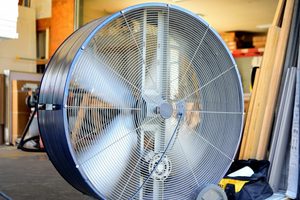
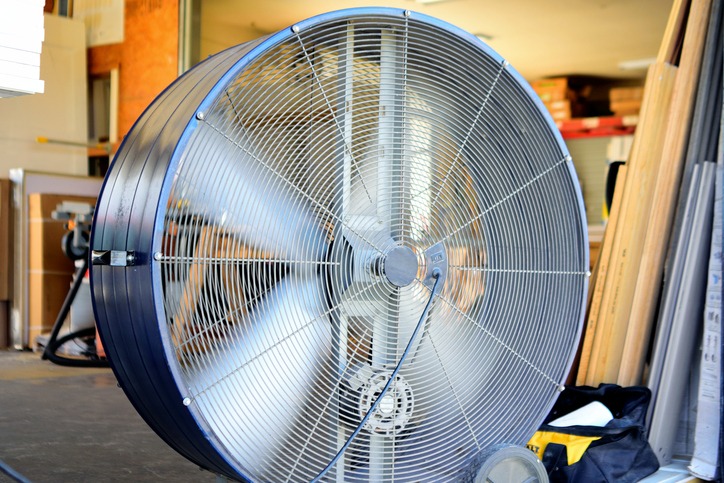
Industrial fans and air movers are generally used when the primary requirement is moving a large volume of air through an open or lightly restricted environment. Typical applications include general ventilation, temporary cooling, drying, and air circulation.
Blowers are generally selected when air has to move through greater resistance. That resistance may come from ductwork, filters, process equipment, confined-space ventilation systems, or other restrictions.
Why Static Pressure Matters
A fan’s advertised CFM does not tell you how much air it will deliver once it is connected to an actual system. Every restriction in the airflow path adds resistance. Ductwork, flexible hose, elbows, filters, dampers, grilles, heat exchangers, and process equipment all require the fan or blower to generate additional pressure.
As resistance increases, airflow can decrease. This is why free-air or maximum CFM ratings can be misleading when selecting temporary equipment. A unit may move a very large volume of air in an unrestricted environment but deliver substantially less once connected to a long duct run.
For rental applications, select equipment around the expected operating point rather than its headline CFM rating.
Airflow and Static Pressure Work Together
Two numbers matter here: CFM and Static Pressure.
- CFM tells you how much air needs to move.
- Static pressure tells you how much resistance the equipment needs to overcome.
You need both.
For example, telling a rental provider, “We need 10,000 CFM,” is a useful starting point, but it does not fully define the application. The provider also needs to know what the air is moving through and how restrictive that system will be.
A 10,000-CFM requirement through a short, large-diameter duct is very different from 10,000 CFM through hundreds of feet of smaller duct with multiple elbows and filters.
That difference can determine whether an industrial fan is adequate or whether you need a high-static-pressure fan or blower.
When Should You Rent a High-Static-Pressure Fan?
A high-static-pressure fan makes more sense when the application still requires high-volume airflow, but the air must overcome moderate system resistance.
This is common in temporary ducted ventilation, confined-space ventilation, exhaust applications, and systems incorporating filters or relatively long hose runs.
The important distinction is that the fan needs enough pressure capability to maintain the required airflow after connecting the system.
Standard Air Mover vs. High-Static-Pressure Fan
There is no single pressure value that universally separates a “fan” from a “high-static fan.” Manufacturers use different terminology and product classifications.
For that reason, performance data is more useful than the equipment name.
| Consideration | Standard Industrial Fan/Air Mover | High-Static-Pressure Fan |
| Primary requirement | High-volume air movement | Airflow through moderate resistance |
| Typical environment | Open or lightly restricted | Ducted or restricted |
| Ducting | Short and relatively simple | Longer or more restrictive |
| Static pressure requirement | Low | Moderate |
| Common applications | Cooling, drying, general ventilation | Ducted ventilation, exhaust, confined spaces |
| Main selection factor | CFM | CFM at required static pressure |
When Should You Rent a Low-Pressure Blower?
A low-pressure blower becomes appropriate when system resistance exceeds what a conventional fan can efficiently handle. Typical applications include process ventilation and exhaust, restrictive confined-space ventilation, fume extraction, combustion or process air, wastewater aeration, pneumatic or material-handling applications, and temporary process-air requirements.
Depending on the required flow and pressure, the application may call for a positive-displacement, single-stage centrifugal, or multistage centrifugal blower. Fan and blower categories can overlap, so base the final selection on the required duty point and manufacturer performance data.
How Ducting Changes the Equipment You Need
Ducting is one of the easiest ways to turn a simple fan application into a higher-pressure application.
A short run of large-diameter duct may create relatively little resistance. A long run of smaller duct with multiple elbows, transitions, filters, dampers, or restrictive discharge points can create considerably more.
Consider a temporary system arranged like this:
Fan → flexible duct → elbows → filter → long duct run → process area
The fan has to overcome the combined pressure losses from every component in that path. This is why duct diameter and length should be part of the rental discussion from the beginning.
A common mistake is selecting equipment based only on the airflow requirement and adding ducting afterward. Ducting changes system resistance, which can shift the fan or blower operating point. The better approach is to consider the complete temporary system before selecting the equipment.
What Should You Know Before Renting Fans or Blowers?
Give the rental provider as much system information as possible:
- Required airflow: Target CFM based on ventilation or process needs.
- Required static pressure: Known system pressure requirement, or enough layout information to estimate it.
- Ducting: Diameter, length, elbows, transitions, filters, and major restrictions.
- Air temperature: Important when handling hot process air or other conditions that affect air density.
- Operating environment: Indoor or outdoor use, dust, moisture, corrosion, and any hazardous-area classification.
The more complete the system information, the easier it is to select equipment that performs as expected after installation.
When Does Renting Fans and Blowers Make More Sense Than Buying?
Temporary airflow requirements do not always justify purchasing permanent equipment.
A plant may need additional ventilation during a turnaround, temporary cooling during a production peak, emergency exhaust after an equipment failure, or supplemental process airflow while permanent equipment is being repaired or installed.
In these situations, rental equipment provides additional capacity without requiring the facility to make a permanent capital investment.
Rental equipment can also be useful when the required capacity is uncertain.
For example, a facility may know its existing ventilation system is inadequate but not yet know exactly how much additional airflow it needs. A temporary fan or blower can provide a practical way to support operations while engineers collect real operating data.
During the rental period, the plant can monitor airflow requirements, pressure stability, equipment utilization, and production conditions. That information can help determine whether a permanent upgrade is necessary and, if so, what capacity the new system should have.
That makes rental equipment more than a temporary fix. In some cases, it becomes part of the engineering decision.
Frequently Asked Questions on Industrial Fans and Blowers
Here are a few of the most common questions for choosing between a fan and a blower.
What if the duct layout changes after the equipment is selected?
Recheck the expected system resistance. Added duct length, smaller duct, elbows, filters, or other restrictions can change the operating point and may require a different fan or blower selection.
Should filters and other accessories be considered when sizing rental equipment?
Yes. Any component in the airflow path can add pressure loss. Include filters, dampers, grilles, fittings, and other accessories when estimating the system’s resistance.
Conclusion: Select Equipment Around the Application, Not the Name
Dynamic Rental Solutions can help plants evaluate temporary airflow requirements and select the appropriate fans, high-static-pressure equipment, blowers, and accessories for the application. The goal is simple: get the required air where it needs to go, at the pressure the system actually requires, without overcomplicating the installation.
Talk with a DRS expert today to build the right solution for your application.