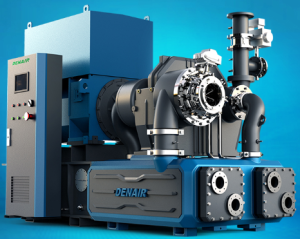

Industrial blowers play a crucial role in various applications across numerous industries. This article reviews what an industrial blower is, how it works, and various types, including their advantages and disadvantages.
What is an Industrial Blower?
An industrial blower is a mechanical device with a design that allows it to move large volumes of air or gas. These blowers typically serve to provide ventilation, reduce heat buildup, remove particulates, or support industrial processes requiring flow of air. Unlike household fans, industrial blowers are built for heavy-duty applications and can handle higher pressures and flow rates.
Why Are Industrial Blowers Needed?
Industrial blowers are an integral part of operations in industries such as manufacturing, agriculture, chemical processing, and power generation. These devices ensure continuous or intermittent airflow and ventilation. Hence, making them indispensable for processes that require precise control of air movement.
In manufacturing, blowers remove harmful fumes, dust, and airborne particles, creating a safe workspace while also maintaining product quality. Agriculture relies on industrial blowers for drying crops and ventilating storage areas, therefore, preventing spoilage. In chemical and power plants, they play a vital role in cooling systems, reducing the risk of overheating equipment, and also ensuring the efficient operation of machinery.
Their versatility and reliability not only enhance productivity but also ensure compliance with safety regulations. This helps in minimizing risks to workers and equipment. By providing critical airflow and environmental control, industrial blowers maintain operational efficiency as well as safety across various environments.
How Does an Industrial Blower Work?
Industrial blowers operate by converting mechanical energy into airflow. They rely on rotating blades or impellers to accelerate air or gas, hence, creating airflow that moves through ducts, chambers, or other systems. Depending on the design, blowers can produce high-pressure as well as high-volume airflow.
Understanding the key components of an industrial blower is crucial to grasp how it operates effectively. Each part plays a unique role in ensuring that the blower delivers the set airflow and also performance in its application. Although these components may vary according to industrial blower types, here are the most common.
Motor
The motor serves as the primary power source for the blower. Most industrial blowers are powered by either an electric motor or an internal combustion engine. The motor’s role is to convert electrical or fuel energy into mechanical energy, which drives the impellers or fans.
Motors vary in power ratings depending on the blower’s size and application. This could be from compact motors for small-scale operations to high-capacity motors for demanding industrial tasks. A properly selected motor ensures optimal efficiency and long-term reliability, while improper sizing can lead to overheating or energy wastage.
Impellers or Fans
Impellers, often referred to as the “heart” of the blower, are the rotating components responsible for generating airflow. They function by creating centrifugal or axial forces to push air through the system. In centrifugal blowers, impellers accelerate air outward by spinning, increasing its pressure and also velocity. Axial blowers, on the other hand, use fan blades to move air along the axis of rotation. Therefore, offering higher flow rates. Impellers come in various designs, including backward-curved, forward-curved, or straight blades, each tailored for specific airflow and pressure requirements. The efficiency of a blower largely depends on the design, material, and balance of the impellers.
Housing
Housing, or casing, encloses the impellers or fans to contain and direct airflow efficiently. It typically consists of durable materials such as steel, aluminum, or reinforced polymers to withstand high pressures, temperatures, as well as corrosive environments. The design of the housing plays a critical role in minimizing energy losses and ensuring smooth airflow.
Inlet and Outlet
The inlet and outlet are the points where air enters and exits the blower. A good inlet design should guide air into the impellers smoothly, thus, preventing turbulence and ensuring uniform flow. Whereas a good outlet design directs the compressed or high-velocity air to its intended application. Both components usually have features like dampers, grills, or filters to regulate flow, reduce noise, or block contaminants. Having good inlet and outlet configurations maximizes the blower’s efficiency by optimizing airflow patterns and also reduces pressure drops.
Different Industrial Blower Types
Industrial blowers come in various designs, with each being suitable for a specific application. Classification of blower types is according to how they generate airflow, as the following sections highlight.
Centrifugal Blowers
Centrifugal blowers use rotating impellers to generate airflow by centrifugal force. The air enters the blower at the center and is pushed outward through the blades into the housing. These types of blowers are common in dust collection systems, HVAC systems, as well as chemical and petrochemical industries.

Here are the most common whys and why-nots of centrifugal blowers.
Advantages:
- High-pressure output, thus, suitable for challenging applications.
- Can handle particulates in the air.
- Operates efficiently under varying conditions.
Disadvantages:
- Larger and heavier in comparison to axial blowers.
- Higher energy consumption for similar airflow rates.
Axial Blowers
Axial blowers move air parallel to the axis of the fan. Moreover, these blowers are popular for their ability to produce large volumes of air at lower pressures. Most of the time, these blowers serve where there is a requirement of a constant stream of fresh air/ventilation. Hence, making them ideal for cooling towers, ventilation in tunnels and mines, as well as the marine and automotive industries.

Here are some advantages and disadvantages of using axial blowers.
Advantages:
- Compact and lightweight design.
- Energy-efficient for high-volume airflow.
- Lower noise levels in comparison to centrifugal blowers.
Disadvantages:
- Limited to low-pressure applications.
- May require additional maintenance in harsh conditions.
Positive Displacement Blowers
Positive displacement blowers (PDBs) use rotating lobes, screws, or vanes to trap air and force it forward through the system. They deliver a constant volume of air, regardless of pressure variations. Because of this reliability, they are common in places like pneumatic conveying systems, wastewater treatment plants, and industrial vacuum systems.
Here’s why you should and should not consider a Positive Displacement Blower.
Advantages:
- Precise control of airflow.
- Can operate in high-pressure applications.
- Suitable for handling gases and liquids.
Disadvantages:
- Higher initial cost.
- More complex design requiring specialized maintenance.
Regenerative Blowers
Regenerative blowers, or side-channel blowers, create airflow by repeatedly accelerating and decelerating air in a circular motion. Moreover, they are popular for their superb control of air quality. They are relatively low-cost in comparison to other blowers on this list, as well as perfect for sensitive applications like aeration in aquaculture, vacuum packaging systems, and use in medical or laboratory equipment.
Advantages:
- Oil-free operation ensures clean airflow.
- Compact and lightweight design.
- Minimal maintenance requirements.
Disadvantages:
- Limited to medium pressure and flow rate applications.
- Can be less efficient for high-demand operations.
High-Speed Blowers
High-speed blowers utilize advanced technology to achieve high rotational speeds, hence, delivering efficient performance in compact designs. They require significant maintenance and technical expertise to operate, but are highly efficient on installation. Due to their extreme speed and control over air variables, they often serve in wastewater treatment, industrial drying systems, and aerospace or defense industries.
Advantages:
- Extremely energy-efficient.
- Compact size and lightweight construction.
- Low noise levels.
Disadvantages:
- Higher upfront cost.
- Requires precision maintenance.
Industrial Blowers at Dynamic Rental Solutions
At Dynamic Rentals, we have an array of industrial blower types with specifications that meet your needs. Our blowers typically range from 3 to 50 psi across a variety of flow rates. Contact us today for more details.