
Temperature control is a cornerstone of safe, efficient, and continuous production in industrial operations. Whether it’s managing the heat load of compressors, maintaining stable conditions for chemical reactions, or preventing thermal stress on equipment, precise temperature regulation directly affects process stability and energy performance. That’s why fluid coolers are essential in many industrial settings. They offer an energy-efficient, low-maintenance solution to remove unwanted heat while maintaining fluid integrity.
This article examines the working principles of fluid coolers, their main types and applications, and the engineering considerations that guide proper selection. It also outlines how Dynamic Rental Solutions (DRS) provides modular, rental-based cooling systems designed for rapid deployment and reliable performance in demanding environments.
What Is a Fluid Cooler?
A fluid cooler is a closed-loop heat rejection system that uses ambient air to dissipate heat from a circulating process fluid, such as water, glycol, or oil. Unlike open cooling towers or refrigerant-based chillers, fluid coolers operate without direct contact between the process fluid and the cooling medium, ensuring cleaner, lower-maintenance operation.
This non-contact cooling method preserves fluid purity, eliminates scaling or biological growth, and minimizes water consumption, making fluid coolers especially suitable for facilities prioritizing sustainability and reliability.
Comparison with Other Cooling Equipment
- Cooling Towers: They use evaporative cooling, where process water comes into contact with air, thus leading to water loss and potential contamination.
- Chillers: Employ mechanical refrigeration for precise sub-ambient cooling, but consume more power and require complex maintenance.
- Fluid Coolers: These use only ambient air for heat removal, thus providing efficient above-ambient cooling without water usage or refrigerants.
In short, fluid coolers serve as a bridge between dry air cooling and mechanical refrigeration, offering efficiency and simplicity for most above-ambient cooling requirements.
How Fluid Coolers Work
Fluid coolers operate on the principle of sensible heat exchange, transferring thermal energy from a process fluid to ambient air without phase change. They are essentially air-cooled heat exchangers designed to reject heat to the environment through a closed, controlled process.
Here’s a step-by-step look at how they work in real industrial environments:
Heat Exchange
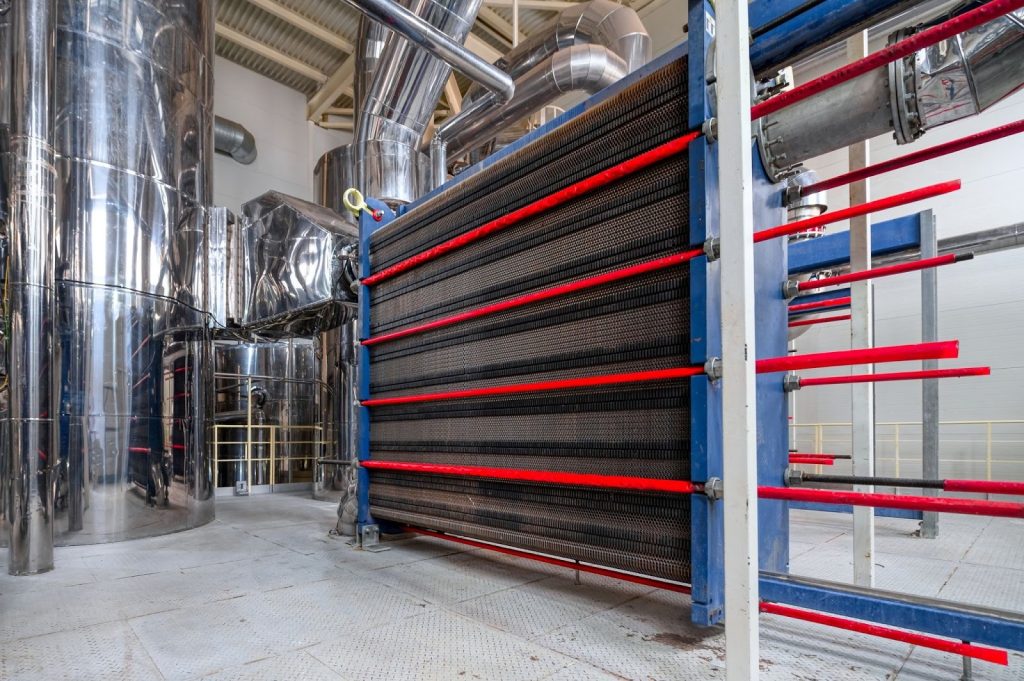
The process begins with circulating warm process fluid, typically water or a glycol-water mixture, from the plant or process loop into the fluid cooler. Inside the unit, this fluid passes through a series of finned coils or plate heat exchangers made of thermally conductive materials such as copper or aluminum. The fins dramatically increase surface area, thus enhancing the rate of heat transfer between the process fluid and the air flowing over the coils.
As the hot fluid moves through these tubes, heat transfers to the coil walls and then to the ambient air. The cooled fluid exits the cooler and returns to the process line, maintaining a continuous thermal cycle.
Air Movement
Powerful axial or centrifugal fans, driven by electric motors with variable frequency drives (VFDs), draw or push ambient air across the coil surfaces. The airflow absorbs heat from the coils and discharges it into the atmosphere. Fan speed modulation allows precise temperature control and helps maintain optimal approach temperatures even when ambient conditions fluctuate.
Advanced systems use EC (electronically commutated) fans or variable-speed drives to optimize airflow dynamically, reducing energy consumption when full cooling capacity isn’t needed.
Closed-Loop Operation
One of the key advantages of a fluid cooler is its closed-loop configuration. The same process fluid recirculates continuously within the sealed system, protected from airborne contaminants, dust, and minerals. This eliminates problems such as scale buildup, algae growth, and corrosion associated with open-tower systems. As a result, there’s no need for chemical water treatment, blowdown, or drift loss management, reducing operating costs and environmental impact.
Many systems also integrate expansion tanks, pressure relief valves, and inline strainers to manage system pressure, accommodate thermal expansion, and protect components from particulate damage.
Free Cooling Mode (Economizer Operation)
During colder months or in cooler climates, fluid coolers can achieve free cooling by rejecting heat using only ambient air, without mechanical refrigeration. When outdoor air temperature is sufficiently low, the fans alone can bring the process fluid to the desired setpoint. This mode dramatically reduces power consumption, as compressors or chillers can be turned off or bypassed entirely.
For example, in Canadian winter conditions, ambient air temperatures can drop well below 10°C, enabling fluid coolers to provide full process cooling without assistance from mechanical chillers. This natural cooling capability makes them exceptionally efficient for northern climates or seasonal operations.
Control and Optimization
Modern fluid coolers incorporate automated controls that monitor inlet and outlet temperatures, fan speed, and ambient conditions. These systems can automatically switch between free cooling and assisted modes, regulate fan operation to maintain stable outlet temperatures, and provide alarm feedback for maintenance or performance optimization.
Some advanced configurations use PLC-based or IoT-enabled control systems, enabling real-time performance monitoring, energy tracking, and remote diagnostics, essential features for critical industrial applications.
Engineering Notes on Fluid Coolers
Fluid cooler performance is affected by several design and operating parameters, with some examples as follows:
- Approach Temperature: The temperature difference between the fluid outlet and air inlet. Smaller approach temperatures indicate higher efficiency but require greater heat transfer surface or airflow.
- Airflow Rate: The volume of air passing through the coils directly affects heat rejection capability. Oversized fans or poor airflow distribution can cause uneven heat exchange and noise issues.
- Coil Geometry and Fin Density: Optimized fin spacing and coil design improve efficiency while minimizing pressure drop.
- Ambient Conditions: Dry-bulb temperature, humidity, and elevation affect thermal capacity and fan power requirements.
Proper engineering selection of fan type, coil material, and airflow configuration ensures the cooler maintains stable and predictable performance under variable process loads and climatic conditions.
Types of Fluid Coolers
Here are the most common types of fluid coolers used in industries.
Dry Fluid Coolers
Dry coolers rely exclusively on ambient air for heat rejection. They are the simplest and most water-efficient type, making them ideal for regions with moderate climates or consistent heat loads. These units use high-efficiency coils and variable-speed fans to balance cooling performance and energy consumption.
Advantages:
- Zero water consumption
- Minimal maintenance requirements
- Simple control and operation
Limitations: Performance decreases as ambient temperature rises above the target fluid outlet temperature.
Adiabatic Fluid Coolers
Adiabatic coolers enhance performance by pre-cooling incoming air with a light evaporative mist or wetted media. This temporary cooling effect lowers the air temperature before it passes across the coils, improving heat rejection capacity during hot conditions.
Advantages:
- Increased cooling capacity in high ambient conditions
- Reduced fan energy use compared to dry-only systems
- Controlled water consumption (used only during peak heat)
Applications: High-load industrial processes, compressor stations, or plants operating in hot, dry regions.
Hybrid Fluid Coolers
Hybrid coolers combine dry and adiabatic modes, automatically switching between them based on environmental conditions. This approach maximizes year-round efficiency by using ambient air for most of the year and limited evaporative cooling only when necessary.
Advantages:
- Optimal balance between water and energy efficiency
- Flexible operation in variable climates
- Extended coil life and reduced fouling
Dynamic Rental Solutions (DRS) offers modular rental units across all three types, ensuring each system is right-sized and site-optimized for the client’s cooling requirements.
Industrial Applications of Fluid Coolers
Fluid coolers are widely deployed across industries that require reliable, non-contaminating, and low-maintenance cooling solutions:
- Process Cooling: Stabilizing oil, glycol, or water circuits in chemical plants, refineries, and manufacturing facilities.
- Power Generation: Removing heat from turbine lubricating systems, generator windings, and auxiliary cooling loops.
- Manufacturing & Plastics: Maintaining mold temperatures in injection molding or extrusion processes to improve cycle consistency and product quality.
- HVAC & Comfort Cooling: Supporting chillers during maintenance, providing seasonal free cooling, or supplementing system capacity during high-demand periods.
- Emergency Cooling: Providing fast-deploy cooling during plant outages, system failures, or unexpected heat spikes.
Why Rent? Temporary fluid cooling systems from DRS are ideal for planned maintenance, capacity expansion, or emergency support. With plug-and-play modular units, sites can quickly restore temperature control without disrupting production or over-investing in permanent systems.
Key Selection Considerations
Selecting the right fluid cooler requires detailed thermal, mechanical, and site-specific analysis. Key parameters include:
- Cooling Capacity: Ensure the unit’s heat rejection rating (BTU/hr or kW) matches process load and fluid flow rate.
- Ambient Conditions: Account for maximum dry-bulb temperature, humidity, and elevation to determine heat transfer potential.
- Fluid Type and Quality: Assess thermal properties, viscosity, corrosion potential, and glycol concentration. For cold climates, include freeze protection systems or heaters.
- System Pressure and Flow: Confirm pressure drop across the coils is within pump capacity and does not impede circulation.
- Footprint and Portability: Evaluate available space, mobility requirements, and access for temporary site deployment.
- Noise and Power Requirements: Meet plant noise restrictions and verify available electrical service for fan drives and controls.
- Integration Compatibility: Ensure seamless connection with existing process loops, pumps, and control systems (e.g., using camlock or Victaulic fittings for rentals).
Proper system sizing prevents underperformance, cavitation, or inefficient fan operation. DRS engineers conduct load analysis and site surveys to ensure each installation meets process and environmental demands.
Fluid Coolers vs. Chillers: When to Use Each
Both systems manage heat, but their cooling mechanisms differ:
| System Type | Cooling Method | Ideal Use Case |
| Fluid Cooler | Uses ambient air (dry or adiabatic) | Fluid Coolers rely solely on ambient air for cooling. They are ideal for above-ambient-temperature control and offer significant energy and water savings through their simple air-side heat rejection process. These units shine in applications where process temperatures can remain several degrees above ambient. |
| Chiller | Uses mechanical refrigeration | Sub-ambient cooling uses compressors, evaporators, and refrigerants to remove heat from the process loop. They deliver precise temperature control but at the cost of higher electrical consumption and more complex maintenance. |
Integration Strategy
Many facilities benefit from combining both systems. During cooler seasons, fluid coolers handle the entire load through free cooling. In summer, chillers supplement or take over when ambient air alone cannot achieve target temperatures.
In many modern facilities, DRS engineers recommend a hybrid approach that combines both technologies. The fluid cooler handles free cooling during cooler months or low-load conditions, while the chiller activates only when ambient air cannot maintain the required temperature. This blended system maximizes energy efficiency, extends equipment life, and ensures consistent process stability throughout seasonal variations.
Why Rent from Dynamic Rental Solutions
When process uptime depends on reliable cooling, Dynamic Rental Solutions (DRS) delivers field-proven, engineered rental systems backed by industry expertise.
DRS Advantages:
- Turnkey Packages: Complete with pumps, hoses, electrical distribution, and automated controls.
- Rapid Deployment: 24/7 response and mobilization from regional hubs for emergency or planned outages.
- Scalable Systems: Modular designs that can be expanded to meet increasing load or seasonal demands.
- Engineering Support: Thermal load analysis, system design, and onsite commissioning to ensure optimal performance.
- Certified and Maintained Equipment: Each unit undergoes thorough testing, calibration, and safety verification before deployment.
Whether supporting a short-term shutdown, augmenting plant capacity, or establishing a backup cooling strategy, DRS ensures your operation stays cool, compliant, and continuous. Get in touch with us today for further information!


