
Aftercoolers play a critical role in the overall efficiency, longevity, and cost-effectiveness of compressed air systems. This article reviews what an aftercooler is, why sizing is important, and sizing methods, including using a size chart and a digital calculator.
What is an Aftercooler
An aftercooler is a heat exchanger that cools compressed air after it leaves the compressor. As air is compressed, its temperature increases significantly, often exceeding 200°F (93°C). This hot, moisture-laden air can cause corrosion, degrade lubricants, and also harm sensitive equipment. An aftercooler reduces the air temperature, thus condensing a large portion of the water vapor into liquid that can be separated and drained.
Types of Aftercoolers
Generally, aftercoolers are categorized based on the cooling medium used to extract heat from compressed air. The two primary types being either air-cooled aftercoolers or water-cooled aftercoolers.
Each type has specific advantages depending on the application, environment, and space availability.
Air-Cooled Aftercoolers
Air-cooled aftercoolers use ambient air as the cooling medium. Hot compressed air flows through a finned-tube heat exchanger while ambient air is forced over the fins using a fan. Heat transfers from the compressed air to the surrounding air, thus reducing its temperature.
Key Features:
- Cooling Medium: Ambient air.
- Typical Heat Rejection: Cools compressed air within 15°F–25°F of ambient.
- Maintenance: Low – periodic fin cleaning and fan inspection.
- Installation: Simple, doesn’t require plumbing or water supply.
- Applications: Portable compressors, general manufacturing, as well as outdoor installations.
Advantages:
- No need for water supply.
- Lower operating costs in environments with good ventilation.
- Easy to install and maintain.
Limitations:
- Performance is limited by ambient temperature.
- Larger footprint for high-capacity systems.

Air-Cooled Aftercooler
Water-Cooled Aftercoolers
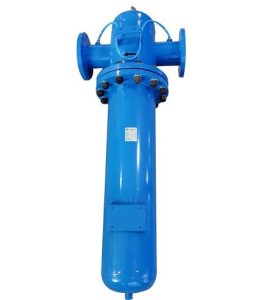
Water-cooled aftercoolers use water as the cooling medium. Compressed air passes through a shell-and-tube or plate-type heat exchanger, where it is cooled by water circulating through the opposing flow path.
Key Features:
- Cooling Medium: Water (often from a chiller or closed-loop system).
- Typical Heat Rejection: Can reduce compressed air temperature to within 5°F–10°F of water temperature.
- Maintenance: Requires water treatment and also periodic descaling.
- Installation: Requires plumbing and a stable water source.
- Applications: Indoor plants, high-humidity environments, as well as heavy industrial applications.
Advantages:
- More effective cooling, even in hot environments.
- Smaller physical footprint than air-cooled units for similar capacity.
- Better suited for high-capacity or high-pressure systems.
Limitations:
- Requires water supply, drainage, and treatment.
- Higher upfront and operational costs.

Water-Cooled Aftercooler
Integrated Aftercoolers (Built-in Units)
Some modern air compressors come equipped with Integral aftercoolers, either air- or water-cooled, built into the compressor housing. These are common in smaller skid-mounted or portable systems.
Key Features:
- Factory-installed and pre-sized for compressor output.
- Ideal for plug-and-play use.
- Reduces installation time as well as space requirements.
Considerations:
- Limited flexibility in upgrading or changing capacity.
- Service access may be restricted depending on the design.
Why is Aftercooler Sizing Important
Incorrectly sizing an aftercooler can lead to multiple system inefficiencies as well as failures. Moreover, an undersized aftercooler won’t remove sufficient heat, leaving the air hot and moisture-laden. This can cause water condensation in downstream lines, reduce the effectiveness of dryers, and shorten the life of tools and pneumatic equipment.
Conversely, an oversized aftercooler may add unnecessary pressure drop, increase energy use, and take up excessive space. In addition, cost is a consideration—overengineering a system without benefit leads to poor ROI.
Correct sizing ensures:
- Optimal heat removal for consistent air quality.
- Minimal pressure loss.
- Longer service life of downstream components.
- Improved energy efficiency.
Aftercooler Sizing Methods
Sizing methods vary depending on the complexity of the system, the accuracy required, as well as the available tools or manufacturer support. Below are some of the most common approaches.
Manual Heat Load Calculations
One of the most fundamental sizing methods involves manually calculating the heat load that the aftercooler must remove. This approach starts by quantifying the heat carried by the compressed air based on its flow rate and temperature differential. Generally, engineers estimate the heat rejection requirement (Q) in BTU/hr as a function of flow rate in SCFM and temperature difference (Tin – Tout), as the following formula shows:
![\[ Q=1.08\times SCFM\times \left ( T_{in}-T_{out} \right ) \]](https://dynamicrental.com/wp-content/ql-cache/quicklatex.com-14f8f1335ca04322bd78c9719c6bc9b6_l3.png "Rendered by QuickLaTeX.com")
This method provides a baseline thermal load, which helps determine the cooling capacity and surface area needed for the aftercooler. While manual calculations offer insight into system requirements, they often require adjustments based on ambient temperature, altitude, and moisture content for more accurate results.
Aftercooler Size Chart
A widely used method for selecting aftercoolers is by referring to manufacturer-provided sizing charts or performance curves. Moreover, these charts relate airflow, inlet air temperature, pressure drop, and cooling effectiveness to a range of aftercooler models.
By cross-referencing the system’s flow rate and desired outlet temperature, users can identify which model meets their needs. These charts are based on actual test data and are especially useful for standard or common operating conditions.
However, in cases where environmental conditions are extreme or unique, relying solely on these charts may lead to inaccurate selection, necessitating further verification or customization.
A simplified example for quick reference:
| Compressor Flow (CFM) | Approx. Heat Load (BTU/hr) | Recommended Aftercooler Model |
| 50 | 25,000 | AFX-50 |
| 100 | 50,000 | AFX-100 |
| 200 | 100,000 | AFX-200 |
| 400 | 200,000 | AFX-400 |
Note: Always consult manufacturer charts for more accurate sizing based on specific operating conditions.
Using Digital Sizing Tools and Calculators
In recent years, many manufacturers have developed web-based or downloadable sizing calculators. These tools allow users to input detailed operating conditions such as air temperature, pressure, flow rate, and desired outlet conditions. The calculator then uses built-in algorithms and performance databases to recommend a suitable aftercooler model or heat exchanger size.
These tools are particularly valuable in complex installations where ambient temperature, cooling medium (air or water), altitude, and duty cycle may vary. In addition to enhancing accuracy, digital sizing tools often help estimate pressure drops, thermal efficiency, and overall system performance.
Engineering Consultation and Custom Design
For critical or non-standard applications, such as those involving corrosive environments, high-pressure systems, or integrated skid-mounted equipment, the best approach is to consult with an experienced engineer or aftercooler manufacturer.
These experts can assess the full system context—including compressor output characteristics, downstream components, redundancy requirements, and also local codes—to design or recommend an optimized aftercooler solution. This method, while more time-intensive, ensures long-term reliability, regulatory compliance, and compatibility with the overall compressed air system.
Aftercooler Sizing Calculator
These are digital sizing calculators where you input:
- Compressor CFM
- Inlet temperature
- Outlet temperature goal
- Ambient air or water temperature
The tool then calculates the required heat rejection capacity and suggests appropriate aftercooler models. This method minimizes guesswork and ensures system compatibility.
The Right Aftercooler Sizing with Dynamic Rental Solutions
Proper aftercooler sizing is essential to protect your investment in compressed air systems. Moreover, it ensures air quality, improves efficiency, and reduces downtime from moisture-related damage. Whether you use a size chart or an advanced calculator, factoring in flow rate, pressure, and environmental conditions is key.
Need help with aftercooler selection or rental? Contact Dynamic Rental Solutions for expert advice and equipment options tailored to your application.